Are you sabotaging your best intentions? How to overcome unconscious conflict
Are you sabotaging your best intentions with food and exercise? Learn how unconscious conflict holds you back and 6 steps to break the cycle.
Are you sabotaging your best intentions with food and exercise? Learn how unconscious conflict holds you back and 6 steps to break the cycle.
Why does the medical field still push weight loss despite the harms of weight stigma? Explore the Semmelweis reflex and the case for weight-inclusive care.
Wondering what it actually feels like to eat enough after years of dieting? Discover how breaking the cycle of restriction can quiet food noise and restore your energy.
Does a social media detox actually work? Discover what recent research says about screen time limits, feed cleansing, and protecting your body image from diet culture.
Struggling with the food comparison trap? Learn why comparing your plate to others is biologically flawed + sabotages food freedom, and five ways to reclaim your nutritional autonomy.
Struggling to tell the difference between physical vs. emotional hunger? Learn how interoceptive awareness can help you rebuild body trust without shame.
Why is body positivity falling short? Mainstream body positivity focuses on self-love, but true equity requires systemic change. Explore the radical shift to body liberation, intersectionality, and fighting medical fatphobia in healthcare
Struggle with rigid workouts? Discover how intuitive movement and exercise snacking can help you heal your relationship with fitness and find joyful movement.
Diet culture can live inside your head. Learn how internalized weight bias impacts body image and health, and explore a weight-inclusive path forward.
Does weight loss equal health? Learn why the weight-inclusive approach is a more effective, research-backed way to support your physical and mental well-being.
Self-care is extra important in times of uncertainty. I’m always an advocate of physical and emotional self-care, because if you don’t take care of yourself, who will? So here's some food for thought, as well as some self-care tips for creating or refining an overall self-care practice that’s right for you.
Exercising in a larger body can feel daunting in today's fitness culture. Discover how to exercise while fat without focusing on weight loss. Learn to ditch the "waiting room" mentality and reclaim joyful movement.
Trapped in a cycle of self-objectification? Discover how shifting from self-objectification to interoception can help you heal from diet culture, reconnect with your body, and eat intuitively.
Think you need to be underweight to have an eating disorder? Learn the hidden signs of atypical anorexia, the dangers of weight bias, and how to find healing.
How do you break the cycle of urgent sugar cravings? It sounds counterintuitive, but the answer is unconditional permission to eat.
Does this sound like you? You value eating healthy, so you spend a lot of time
A key part of habit change is awareness. If we’re not aware of our habits, we can't change them. But there’s a problem with awareness...the messy middle.
There are a lot of reasons why people skip meals. Missing a meal occasionally isn’t a big deal, generally speaking. But when skipping meals happens frequently, even habitually, there are some real risks.
If you feel like diet and weight loss medication talk is everywhere all the time and you’re sick of it, intuitive eating be an attractive, enticing option. Unfortunately, there’s a common misconception that intuitive eating is just the “hunger and fullness diet.”
Nutrition therapy can feel similar to mental health therapy. That’s because what you eat isn’t just about the food. It’s also about why you eat, how you eat, where you eat, and so on.
Between holiday parties, cookie-baking coworkers, peppermint lattes and family members pushing second (or third) helpings at the holiday table, it’s easy to fall prey to one of two extremes: plunging into overindulgence or retreating into restriction.
One question I ask all my new clients is, “Do you believe you have to
The holidays are just around the corner, and for a lot of people they can feel overly stimulating. Maybe not the entire holiday season, but certainly parts of it. Here's some self-care that may help.
If you’ve ever said, "I want my teenage body back,"you’re not alone. But there is no universe in which you will have that body back...not even close.
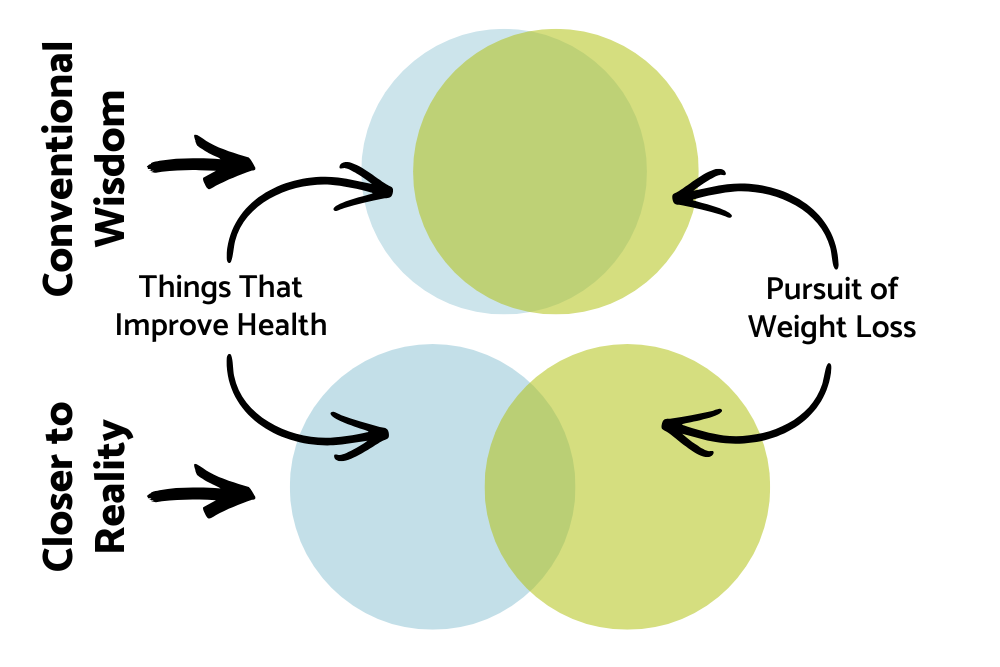
If you’re trying to lose weight, is it for appearance, or is it for health? I encounter many people who on one hand, say they know that dieting isn’t good, but that’s OK because they want to lose weight to be healthier. But the intentional pursuit of weight loss is not a harmless escapade.
“Don’t eat after 7 p.m.,” “Close the kitchen after dinner.” This advice is so frequently repeated (typically directed at people who are trying to lose weight or avoid gaining weight) that it’s taken on a veneer of truth and common sense.
This post is part of my “Know Better, Do Better” series, in which I revisit an old blog post that makes me cringe because my thinking has evolved substantially since I wrote it. I wrote the original post in 2012. Please enjoy my snarky current day comments, aimed at my past self (but with compassion).
“I’ll never be able to change.” I hear those words all the time from clients. Maybe you’ve said (or thought) them yourself. The reality is that people change all the time. We’re constantly changing, whether we know it or not. To be alive is to be changing
Research shows that self-compassion is important for mental and emotional health and well-being as well as for physical health. Learn how to cultivate more self-compassion in your own life.
Eating disorders are mental health disorders that can cause serious medical complications. This is true even if someone isn't underweight. Unfortunately, the weight-centric healthcare system feeds stereotypes about what eating disorders “look” like.
Our bodies carry us through this world — aren’t you glad you aren’t just a mass of free-floating consciousness? — but they can also hold us back. Often, that’s not because of our bodies, per se, but because of our mindset.
Why diet culture causes harm to everyone, even if you've never dieted. How? By impacting relationships, affecting how you view food and your body, and warping your view of what it means to be healthy.
The onslaught of ads and articles about new weight loss medications has "normalized" taking one of these medications, which has contributed to increased weight loss talk. How can you set diet talk boundaries?
Someone asked me recently if it’s possible to feel comfortable physically at a weight that is higher than you have ever been. As with so many questions, the short answer is, “Yes,” but the long answer is highly nuanced.
I’ve seen up close and personal how intuitive eating has helped many of my clients develop a peaceful, balanced relationship with food. I’ve also seen how the path to adopting intuitive eating can be quite different in young adult women than it is for women in midlife or older.
It’s estimated that 9% of Americans* will develop an eating disorder in their lifetime, but a fraction of those will receive a diagnosis, and even fewer will receive effective treatment. Why is it so hard to diagnose an eating disorder? Eating disorder stereotypes are one obstacle.
The idea of food addiction is controversial. Perhaps even more controversial is the current belief that ultra-processed foods, specifically, are not only addictive but intentionally designed to be so.
Feeling stressed? All caught up in thoughts and worries? It can help to get out of your head and into your body. One effective way to do that is grounding.
Do you feel like you need to strive for optimal nutrition? This sort of all-or-nothing thinking can interfere with health and happiness. Gentle nutrition and eating competence offer an alternative.
You’re in the exam room at your doctor’s office. Maybe it’s for an annual check-up. Maybe you’re there for a specific concern. Then it happens. They recommend a GLP-1 for weight loss. What do you do next?
If self-esteem and self-compassion were horses, self-compassion would win every time. Why self-esteem can fail you, but self-compassion can help you quiet your critical voice.
The pursuit of thinness can get so tangled up in the pursuit of health that it's hard to know if the actions you're taking are actually making you healthier.
How to quiet food noise is a hot topic. But weight loss meds aren't the only way to stop those cookies from calling to you from the kitchen. Here are three very different strategies.
When we know what behaviors and habits help us feel our best, you would think it would be adequate motivation for doing those things…yet often, it’s not. What’s the deal?
The "obesity epidemic" emerged in 1976-1980. Could dieting mothers in the 1960s and 70s have contributed? What clues does science offer?
Not feeling great about your body or your eating or exercise habits? Instead of falling for diets in disguise, consider what wellness really means.
Dealing with food pushers can take some of the joy out of holiday meals. Here's how to set your food boundaries and enforce them with grace.
Abundant research shows that if you are more self-critical, especially if you're also a perfectionist, you are likely to have less self-compassion and at higher risk of disordered eating or eating disorders.
Joy is a big part of Intuitive Eating and other non-diet approaches to health and
If you’ve ever had a bout of food poisoning, traveler’s diarrhea or the “stomach flu,” only to have some of symptoms stick around for the long haul, what may not have crossed your mind is that you suddenly developed irritable bowel syndrome.
When you struggle with negative body image, the possibility of ever having positive body image may feel like an unreachable goal. But research has identified several common themes in successful body image journeys.
Carbs have been getting a bad rap for quite a while. But carbohydrates come from plants, and many plant foods are rich in the vitamins, minerals, phytochemicals and fiber that are vital to good health. In spite of this, carb-phobia persists. Here are some of the myths about carbohydrates that are getting in the way.
For many people with irritable bowel syndrome (IBS), the low-FODMAP diet can feel like a miracle. But is the low-FODMAP diet right for everyone?
Anyone of any body size can internalize weight stigma, which can harm both physical and mental health. But when it comes to weight stigma, generally, all bodies are not in the same boat.
We often approach habit change with the wrong attitude. We criticize ourselves. We strive for “perfect” instead of “good enough.” We try to make changes that someone else says we should make, without really taking the time to decide what WE want. All of that is a recipe for failure.
If you have IBS and struggle with abdominal pain, gas, bloating, diarrhea or constipation, can a low-FODMAP diet help?
This post is part of my “Know Better, Do Better” series, in which I revisit an old blog post that makes me cringe because my thinking has evolved substantially since I wrote it. Thank goodness.
Becoming more aware of your thoughts, feelings and emotions gives you more choice in the actions you take. This has two important benefits. One, it allows you to stop living on autopilot so you can begin to unhook from habitual, unhelpful patterns. Two, it makes it easier to respond rather than react to whatever's happening in you and around you.
Weight-inclusive care is an approach that assumes that patients of all weights are capable of achieving health and wellbeing if they have access to non‐stigmatizing health care. This approach also challenges the belief that a particular BMI reflects a particular set of health behaviors, health status, or moral character.
Does intuitive eating mean eating whatever you want, whenever you want, as much as you want? That's certainly what many people believe. The simple answer is, “No.” But I also want to give a disclaimer.
It happens to all of us. You see a photo of yourself and don’t like what you see. You’re getting dressed and hate how your clothes look on you. You’re in a body image spiral, and you’re in danger of circling the drain. Here's what to do.
When you don't have fond feelings for your body, you might be hesitant to show more than a few inches of skin, even when the temperature rises. This can leave you physically uncomfortable for much of the summer..and interfere with participating in summer activities.
As with many ideas that suddenly start to grow in popularity, the central tenants of intuitive eating can be easily misinterpreted. If you're starting to practice Intuitive Eating, you may get some interesting comments and questions from family, friends and co-workers.
The current state of "body positivity" means the term has almost no meaning any more. That's why body liberation is the more empowered path.
I believe in the power of nutritious food. I’m well-versed in what scientific research says about the role of the food we eat in preventing chronic disease. But I also that nutrition is not the sole, and often not the most important, determinant of our health.
There’s this myth that adopting an anti-diet approach is also anti-nutrition. The truth is that you can absolutely eat a nutritious, balanced diet with lots of variety without being restrictive or rigid about it.
The key to understanding what Health at Every Size really is in their newly revised principles, which focus on bias-free healthcare access.
The Washington Post just published a hit piece on anti-diet dietitians. It shows how very little they understand about what they're attacking.
I’m often asked what “non-diet” actually means, both in general terms, and specifically when a
Self-compassion (and compassion) are infinite resources. You don’t need to fight for your slice of the compassion pie AND you don’t need to deny yourself compassion because someone “deserves it more.”
There are many things kids have to do that they may not consent to (like homework). But those things don’t do damage the way non-consensual dieting does.
What's authentic health? Authentic health happens when you weigh any external health advice against your own experience before deciding whether to incorporate it. This supports health while helping you break away from diet culture.
If you’re not celebrating intentional weight loss for any other reason, and you know that weight doesn’t equal health, should you congratulate someone for losing weight for "health reasons"? In a word, no. And here are more words explaining why.
Do you find it challenging to form habits that last? It may be because you haven't identified your values. And if you haven't, then you're not using values to guide your daily actions.
When you’re charting a path away from diet culture, it helps to be mindful of your thoughts and words. Are they still reflecting diet culture?
Food and body shame is futile, because it's not motivating, and perilous, because it does real harm. What to know if you're struggling.
Do food-centered holiday social events make you feel a bit anxious? Here are some mindful holiday eating tips that might help you enjoy that next holiday party or buffet more.
Once upon a time, holiday foods stood out as highlights in a year of relatively simpler fare. But in today’s food environment, with its year-round access to delicious and even indulgent foods, it’s as if the holiday season has upped the ante, making the holidays feel like a minefield.
If you already tend to have anxieties about food, holiday eating can make you especially anxious. Here’s some food for thought about how to approach holiday eating that brings you joy and leaves you feeling good, too.
Why is it important to get more pleasure in your life? One, because you deserve it, and two, it can help your relationship with food.
What's wrong with the latest study supposedly showing how "successful" WeightWatchers is? So, so much. Let's start with the missing people.
If you’re intrigued by intuitive eating, or at least heard of it, you might wonder what you need to consider, or perhaps do, before giving it a go. Here are three factors that I think are important.
As a registered dietitian and journalist who used to write for The Washington Post, I was deeply dismayed by the clickbait “gotcha” journalism of their September 13 article, “The food industry pays ‘influencer’ dietitians to shape your eating habits.”
You know what bothers me? The idea that anyone needs to change their body to meet someone else's ideals. That "someone" could be a spouse/partner, a friend, a stranger, or society at large.
When you think of mindfulness, do you dismiss it as a trend? It’s true that mindfulness is trendy, but it also has deep, traditional roots that are backed by modern research in the fields of psychology and neuroscience.
Health may be a personal value, but it’s also become a yardstick by which to measure other people’s value and worthiness. Are we encouraged to have a health-based identity, to think of ourselves as healthy
When you’re moving away from a history of dieting and body dissatisfaction toward a future of intuitive eating and body respect, appreciation, or liberation, self-compassion can be a powerful tool.
Why can it sometimes feel easier to just keep trying to lose weight than it is to accept your body as it is? Here are some reasons why you can be exploring, even practicing, intuitive eating and body acceptance, but still want to lose weight.
Dieting to lose weight (even under the guise of “lifestyle changes”) is so normalized in our culture that it indeed feels normal. And if it’s “normal” it must be OK…right? Let me break this to you gently — not only can dieting lead to disordered eating, but in many cases, dieting IS disordered eating.
There are a lot of myths about intuitive eating. One is that you can’t learn or practice intuitive eating if you have a chronic disease. You absolutely can, because it can help you both enjoy your food while you're caring for your health.
Habituating to forbidden foods can feel challenging. While making peace with food involves some mental aspects, to take it all the way and habituate means actually practicing eating those foods.
One of the so-called “holy grails” of practicing intuitive eating is the day when you have become habituated to formerly forbidden foods.
“Body positivity” is a buzzy catchphrase that has deep origins. But is body positivity achievable, even in today's watered-down version?
The second edition of my book, “Healthy For Your Life” is now available on Amazon. This new edition is revised and updated as well as expanded, with 80 more pages, new recipes, and selected citations. It also has a new subtitle: “A non-diet approach to optimal well-being.” Here’s are some excerpts.
How does pleasure work with intuitive eating? If you are honoring the intention behind intuitive eating, then you are eating for pleasure.
Self-care is extra important in times of uncertainty. I’m always an advocate of physical and emotional self-care, because if you don’t take care of yourself, who will? So here's some food for thought, as well as some self-care tips for creating or refining an overall self-care practice that’s right for you.
It used to be 'health is wealth.' Now, health is a modern form of 'cultural capital.' For many people, this means performing 'health,' which can become harmful.
This isn’t the first time I’ve written about self-compassion. It also won’t be the last, because self-compassion is that important, including for easing shame and increasing motivation.
There are many words we can use to refer to bodies, including body size. When deciding how to talk about fat bodies, two words I've stopped using are "ob*sity" and "ov*rweight." And when I have to use the O-words, I use them carefully.
While moving toward Intuitive Eating and away from years or decades of dieting is work well worth doing, there are many reasons you might have struggled. Let me talk about some of the most common reasons.